Abby Harach
English 120
Professor Borcoman
3/30/26
Crafting your own way to household hygiene
While most people quickly check their carts with the next big hit of products advertised to either successfully clean any surface of your home, or completely transform your living space into a whole new house, there are others that decide to look away from purchasing any commonly found brand of cleaning product in their household. Do It Yourself or “DIY” groups are a subculture most commonly associated with the action of making your own necessities instead of adhering to the consumerism market of big brands and flashy advertisements.
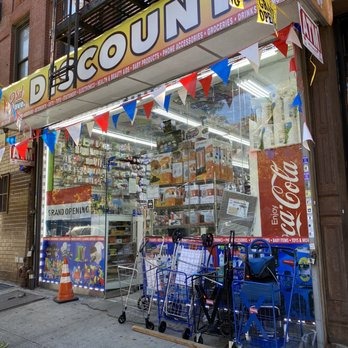
On the upper east side of Harlem, there is a local convenience store right alongside the emmerson deli that I live near on 3rd avenue 100st NYC. In this particular store, people go in with a similar mindset of obtaining a handy or quick product to satisfy their goal at that exact moment. I ran into many instances where this convenience store saved a mishap in the kitchen, or saved me time and money to buy a brand new set of markers for a school project that needed to be handed in the same day. Products like vinegar, baking soda, and even some essential oils are selected from the shelves to make bars of soap as it is a hygiene necessity that needs to be restocked. For individuals who are just starting to look into getting into the subculture of making your own cleaning and hygiene products, this convenience store in particular aids and even encourages in the curiosity of doing so by stocking products next to each other with subtle hints around the placement on what products work well together, and how they work well. The pairing of dawn dish soap and white vinegar make a perfect surface cleaner without any additional chemicals or bigger price tag attached. I later notice a mother and her two children enter the convenience store. “ Mom can we get this” “No, we have that at home, love.” A box of baking soda is held in one hand and in the other, a silicone mold shaped as four leaf clovers.
The phrases “ we have it at home” or “I can make that for a lot cheaper and better” became very common in my time surrounded by locations just like the convenience store and even in my own home. Growing up in an immigrant household where soup was the main staple for a nutritious but cheap dish, I came to become very familiar with the term “ doing it yourself” and cleaning products were no exception. Just like the fluorescent lights highlighting the many different items on the shelves, my home became the pinnacle “ingredient household.” Fresh lavender filled the kitchen as my mom poured her new concoction into a reusable old spray bottle that consisted of very commonly found ingredients while the cool breeze of early spring air lifted the mood of the dim apartment. Saving on cleaning products was not only a common practice in my household, but a simple act embedded into our cleaning routine. “It is generally agreed that sub-cultures resist assimilation to the wider, dominant culture, yet this resistance gradually yields to the necessities of earning a livelihood and raising a family in a context suffused with ideas, behaviors, and objects that seep through the membrane separating the subculture from the surrounding world” – Dowd, James J., and Laura A. Dowd. “The Center Holds: From Subcultures to Social Worlds. This particular quote from a publication under the “American Sociological Association” introduces the aspect of familiarization and integration of a lifestyle, like making your own cleaning products, a common practice within particular households like mine and many others with similar situations. Yet when noticing the integration of lifestyles like “DIY,” within multitudes of common practices including hygiene, physical places like our own homes or the convenience store on 3rd av are not the only atmospheres where people can experiment or find similar interests surrounding this subculture.
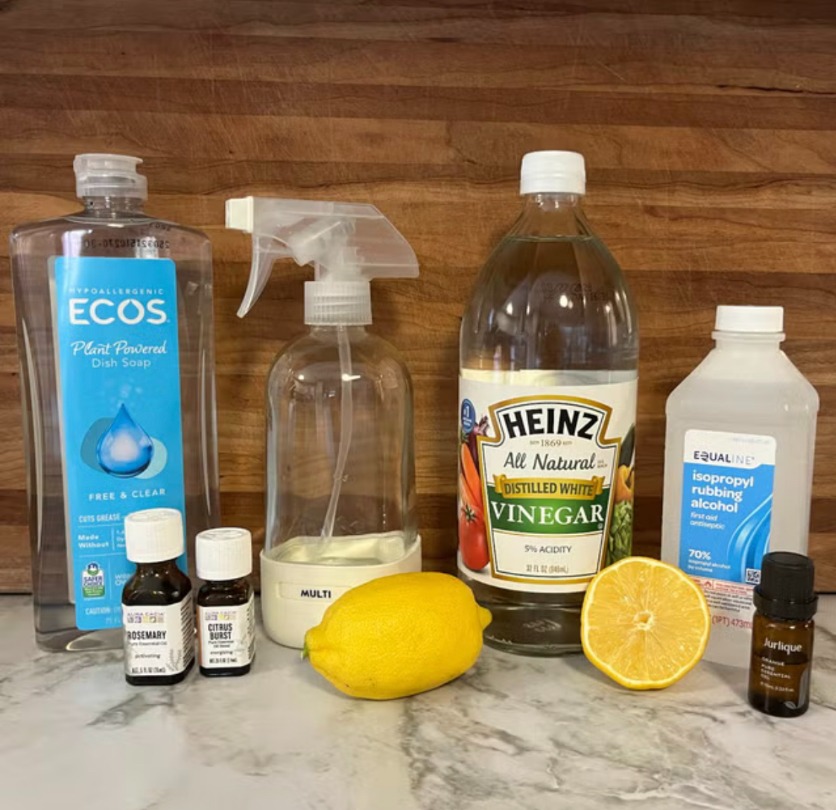
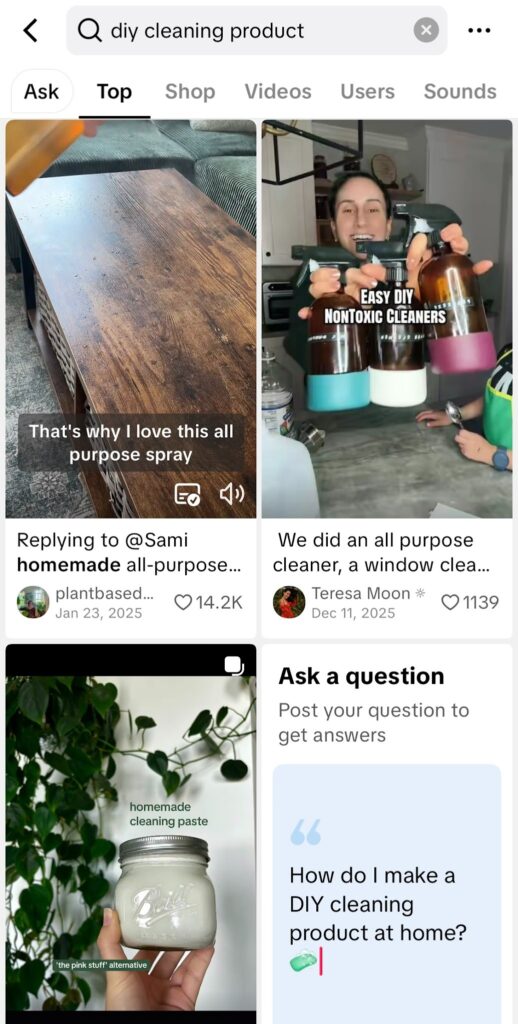
The repetitive buzzwords like “found at home” and “easy to make” hook people like my own family instantly, as well as in subreddits and tik tok communities, so why don’t all people join in on the creatives who try to reduce the amount we spend on home cleaning products?
“A third type of subculture-and the one least likely to assimilate-includes all groups defined not on the basis of an ascribed status characteristic like ethnicity, but rather on an achieved, or volitional, characteristic such as a common world view, political or religious beliefs, or lifestyle preference (Talbot 200) – Dowd, James J., and Laura A. Dowd. “The Center Holds: From Subcultures to Social Worlds.” The characteristics of people that tend to join subreddits or in-person communities that share tips/ tricks on how to obtain the best recipe for a household cleaning solution usually tends to be individuals who are either environmentally conscious, want to save money, like simplicity in their products, or all of the above.
When searching through social media for ideas, the subreddit “moderetlygranolamoms” pops up as a first recommendation. Under this post, the question is “ Give me a run down of your homemade cleaners and what you use them for!” and while there are a bunch of posts recommending numerous combinations of ingredients for specific cleaners, many include phrases like “no harsh chemicals compared to all the mystery ingredients” attached to their recommendations to appeal to the specific audience that tends to relate to these groups, while also enhancing their reliability through similarity. People start listing combinations up and down, and some I never thought of like the use of pure vodka and water for the removal of bacteria/ odors for fabric.
Some people may argue that it’s not convenient enough to save a couple of dollars, especially when someone has an already busy schedule and does not have time to make their own products. Conflict constantly has a way of creeping up on social media platforms specifically, even in content sharing “frugal lifestyles and habits.” The thought of living on a budget or having to constantly ration certain products is completely outside the familiar norm of most people who tend to look for mainstream consumer products for their own household hygiene. Terms like “unhygienic” and “over the top” tend to come up against subcultures that choose to make their own products, but for most families like mine and the mom at the convenient store’s, it is an essential aspect of our own lifestyle that helps maintain a good balance between spending on excessive products and essential ones.
Although going against D.I.Y cleaning products is the case for many people, especially busy New Yorkers, individuals within the DIY aspect of this subculture argue that preparing your own household cleaning products are beneficial both for your own health and ecologically in the long run. A New York Times article labeled “ Do D.I.Y Cleaners really work?” publicist Ronda Kayson inspected this tension with a conclusion backed by research. The interest in do-it-yourself cleaning formulas comes out of a growing anxiety that products sold on supermarket shelves may contain harmful chemicals, and many potentially include volatile organic compounds known to cause asthma, headaches, allergic reactions, and potentially even cancer or organ damage. The nonprofit advocacy organization labeled as the “Environmental working group” reviewed more than 2,000 cleaning products, and found that more than half contaminated ingredients that irritated the lungs. With sources such as this NY Times article and James J Dowd and Laura A. Dowd’s The Center Holds: From Subcultures to Social Worlds where it’s discussed people essentially adapt and obtain new and unique subcultures into their typical “norm” through sociology. “Counter-cultures actively resist assimilation, while other types of subcultures are far less likely to do so. Placing the emphasis not on behavior but on pressure towards assimilation avoids the many vagaries and arcane distinctions (and the resulting confusion experienced by students) that are the predictable result of efforts to classify similar groups into not only different but opposed
Categories” -Dowd, James J., and Laura A. Dowd. “The Center Holds: From Subcultures to Social Worlds.” As I venture throughout the little area of east harlem that I call home, I realize not everyone is perceived the same, and especially bec
DIY home products reflect a broader shift toward creativity and personalization in everyday life, and communities comprised of this type of subculture thrive on shared knowledge, online tutorials, and experimentation, so If it is either through aspirations of a new found love for crafting, cutting back on spending, or wanting to obtain a cleaner and more eco-friendly lifestyle, people such as my parents and the mom with her two children in the convenience store both find individuality within this small subculture within their larger mainstream cultural norms.
Sources
- Ronda Kaysen, “Do D.I.Y cleaners Really Work?” N.Y. Times article, 2019 NY Times Article
- Dowd, James J., and Laura A. Dowd. “The Center Holds: From Subcultures to Social Worlds.” Teaching Sociology, vol. 31, no. 1, 2003, pp. 20–37. JSTOR, https://doi.org/10.2307/3211422.
AI Transparency Statement:
I didn’t need any AI in my writing unless it was the AI feature used when looking up academic sources on google.

This entry is licensed under a Creative Commons Attribution-NonCommercial-ShareAlike 4.0 International license.

