Abby Harach
English for Social Sciences
Professor Borcoman
March 2nd 2026
Watching a version of me become “we”
Abdul defines culture in a more physical and visual aspect. Radios crackle to life with highlife music or morning news in Twi, Ga, or Ewe. Hums and rhythmic chants fill the dawning atmosphere as Abdul’s mom prepares a very famous and filling staple of fufu and egusi. Rich, yet nutty aroma escapes through each crevice of the home with a reviving nostalgia, familiarity, and security. Dances, storytelling, and food are some of the main aspects of culture that highlight community, togetherness, and respect that Abdul grew up with as a child, and is why he still, as a young adult, remains to stick by this view on culture.
Coming back to the impact of Abdul’s culture, he emphasizes that “A person’s Marriage” is an especially impactful and significant event that helps define what his culture truly embodies. He emphasizes the importance of “a person” and not a specific individual that is familiar to him because, in his culture, marriage/ weddings are open for anyone to witness and join and not just close friends and family. It is the aspect of togetherness and community that Abdul finds truly inspiring when he talks more about his experiences where his culture is prevalent. “Marriage in my culture is not only for close friends and relatives, but for everyone.” No lawyers or churches. Just people coming together.” This type of stance on a very personal and special moment in an individual’s life is something that really stood out to me and my experience because of its vulnerability surrounding other cultures’ views on private moments.
– “Some live by love thy neighbor as thyself,
others by first do no harm or take no more
than you need. What if the mightiest word is love?” Alexander, Elizabeth. “Praise Song for the Day.” Graywolf Press, 2009.
When going into key components of someone’s culture, I found that a prevalent access point was engaging in mutual understanding surrounding me and Abdul’s cultural upbringing. To be more specific, we were able to let the vulnerability of our stories connect and bring up mutual understanding of one another’s experiences. Some of these experiences include what values are the most important in our families and that similarity was discipline and respect. “ You always got to have a word with an elder.” Abdul’s values of discipline and respect shows through his high regard and respect for his elders in particular. I asked if he mainly only took “elders” ‘respect into a higher regard compared to people who may not be of that particular age and he asked me: “Well, would you trust in me or someone like your parents?” and I came to a stop because in my mind my parents have not always been right nor the biggest influential people in very specific contexts, but in general I had to agree. That is one area in which I saw our cultures somewhat differ. These differences are what I believe is important to come into view to better embrace your own cultural beliefs because indifference fades, and you become more aware of the various different ways in which you judge your culture and theirs. This in turn allows for a more open-eyed view of your choices in life. An outsider’s perspective different to your own can bring fresh insights and questioning into your own beliefs and how you decide to go about your life. New perspectives bring open-mindedness, a better intellectual mindset for curiosity and healthier relationships/ interactions with views that you may not 100% agree with. Some things that may get lost is nuance or potential misinterpretation and skepticism (lack or trust) from another person because of their openness to their opposing views. Many people don’t like to open up about their culture simply because they fear they may be distanced from certain friends or family. This is unfortunately a mindset that is heavily embedded in my family’s culture, yet I choose to stray from it. “Bonding with people no matter how close they are is something that I feel is important for people from other cultures to understand surrounding my culture. Since some people may find it a little strange, but in my culture, that is where you become immersed in the community.” This quote from Abdul really stuck with me regarding the community aspect of culture and has even opened my perspective to my own culture.When observing and comparing our own culture to others, authors like Zadie Smith express noticings like,“Throughout his campaign Obama was careful always to say “we.” He was noticeably wary of “I.” By speaking so, he wasn’t simply avoiding a singularity he didn’t feel, he was also drawing us in with him.” Speaking in Tongues (4) These focuses show a type of togetherness that Abdul keeps in higher value and therefore, allows community in familiarity to become very common in almost every culture, but community in difference and the unfamiliar is something that I started to notice more even in my culture once I started to search for it. From similar hobbies like football (soccer), to the unfamiliar like traditional Oware, Abdul and I have found aspects of familiarity and connectedness in the “extraordinary” of each other’s ordinary parts of our life surrounding our culture. Abdul described Ghana as a vibrant memory of his upbringing, highlighting hobbies, experiences, and lessons learned.
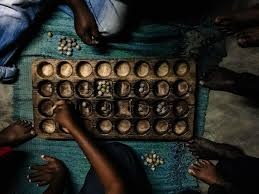
“ Oware is this game where you put marbles into this wooden board with dips, but me and my family used to play with marbles and use holes in the ground.” Simple games like Oware to Abdul took notice of his culture’s traditional methods of community building through games and others, and realized the importance of using resources to their full advantage. In American society, me and Abdul agree that some of our values do carry very preveniently into our everyday life but sometimes there is resilience in acknowledging that there are many cultural views we don’t agree with yet it is not ignorance to those views that carry forward, but a finding of common ground.
AI Acknowledgment & Usage
I used AI for the sole purpose of helping me find sources for articles, poems, and other inspirational media to better compare to my writing/ Abdul’s own story and cultural experiences.
I also referenced the google AI to help with any citation errors I might have done.
Citations
- Smith, Zadie. “Speaking in Tongues.” Changing My Mind: Occasional Essays, Penguin Press, 2009, pp. 3–20.
- Alexander, Elizabeth. “Praise Song for the Day.” Graywolf Press, 2009.
Cultural Profile Reflection
Throughout the process of developing my cultural profile, I noticed that my strengths come in the form of developing a solid and straight forward thesis/ goal of what my writing is supposed to be aimed toward and focused on, as well as my implementation of outside sources that support my writing.
Some weaknesses have been my overall structure of my writing and overall flow of writing, this includes the implementation of transitions, cohesive idea sectioning and connecting, and simplicity when connecting two or more ideas within a single paper.
Some overall goals I have for my writing is to advance and get better at my listed weaknesses I noticed throughout my cultural profile, while also aiming to obtain better ways to simplify my writing to the extent where it doesn’t come off as too confusing to a reader who is seeing my writing for the first time.
I believe that my skills in creative writing are a little bit stronger than my academic writing due to the somewhat lack of consistency in my structure in terms of visual presentation (paragraph structure) but within my cultural profile I found the observation aspect to be helpful in terms of condensing my ideas into a cohesive thesis, with a much better formulated essay structure than what I would normally write.
The incorporation of the importance of a visual agenda increased my engagement into my own writing rather than just simply “writing stuff down” for a grade. ( Writing about engagement with my own surroundings has helped the way I write to my intended audience.)

This entry is licensed under a Creative Commons Attribution-NonCommercial-ShareAlike 4.0 International license.

